

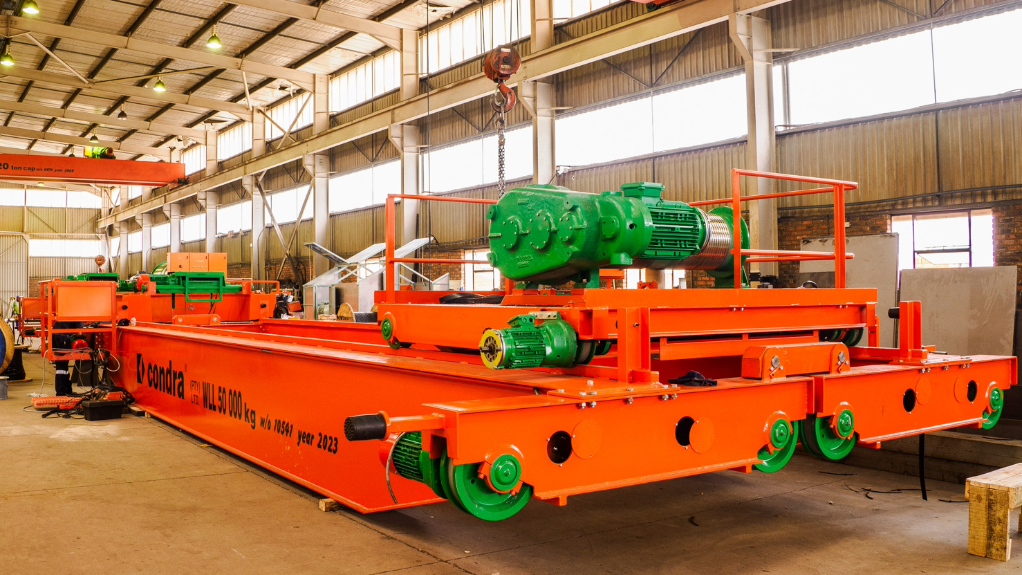
Lifting equipment supplier Condra Cranes & Hoists is working on multiple refurbishment projects, including a 10 t crane for a client in Nelspruit, Mpumalanga, and a 5 t crane with 19 m span for a client in Durban, KwaZulu-Natal. Other projects include hoist and crawl combinations.
Having previously completed the refurbishment of a 40 t, 21-m-span, double girder, electric overhead-travelling crane for a power station, in Mpumalanga, Condra MD Marc Kleiner notes that the then 39-year-old crane was returned to service after a three-week overhaul and refurbishment project by the Condra team, undertaken at the company's main factory in Germiston, Gauteng.
The refurbishment comprised the integration of a two-speed 36 kW/12 kW motor, as well as a conversion from twin 20 t hoists to a single 40 t unit while retaining a smaller 16 t auxiliary hoist already fitted to the crane, Kleiner explains.
“The single 40 t replacement hoist was installed on an improved crab, delivering a variable cross-travel speed of up to 20 m/min. The hoist . . . has fixed lifting speeds but was equipped to allow [for] the fitment of variable-speed drives in the future. [The] lifting height was 8 m.”
He notes that, since that milestone refurbishment project, the company has continued to offer clients a turnkey crane refurbishment solution, which “delivers them peace of mind of original equipment manufacturer refurbishment in accordance with best practices”.
As an example, Kleiner cites the refurbishment of a 5 t portal crane with a 12 m span, for which Condra is currently preparing a quote.
“This crane was purchased by our client in 1990 for over R160 000. The crane will be disassembled down to the bearings. All bearings and seals will be replaced, and the girders will be extended by 500 mm and reassembled as a double girder crane for a workshop. The total cost will be around R150 000; whereas a new equivalent crane today would cost around R480 000,” he explains.
Crane refurbishment, therefore, generates cost savings for a client, with the refurbished crane also being a more modern, “as-new” product, with the added benefit of familiarity, thereby negating the need for operator retraining.
Kleiner adds that Condra specialises in mechanical upgrades that will optimise crane and hoist operations. This includes technologies such as frequency drive unit upgrades and digital load cell displays; and standard mechanical upgrades, such as lifting height and capacity increases and decreases, as well as span extensions and reductions.
Full automation, while often quoted for, has yet to be ordered, he notes.
Going forward, Kleiner encourages industry clients to ensure that their lifting solutions are in good working condition – paying special attention to service availability, certification and testing – to ensure that their operations are efficient and safe.
“We are . . . under extreme pressure to compete on the local and international markets. Imports from the East are, in some instances, considerably cheaper, but not always reliable or compliant with applicable standards . . . Condra’s crane upgrade options are offered across the board during any refurbishment, from standard 2 m workshop cranes to the higher performing machines such as Class 3 and Class 4,” he concludes.