


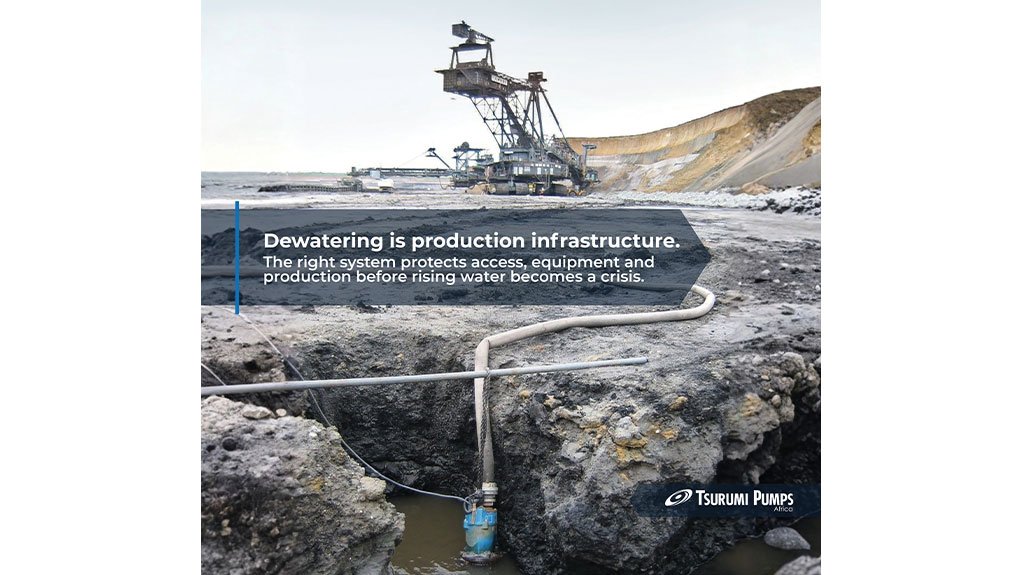
Undetected water seepage on mining operations can lead to complications such as a sump filling faster than expected, a muddy haul road, a pump operating beyond its intended duty, and maintenance teams under pressure – all leading to production losses. By the time flooding becomes visible, costs have often spiked because of lost production time, impeded transport and greater pressure on equipment, says Tsurumi Pumps Africa representative Shaun Kotze.
Real Costs
He explains that the initial cost of a pump should be compared with the overall costs of repeated dewatering failures, higher energy use, damaged infrastructure, lost shifts and delayed mine development.
Pump discharge size and motor output are not the only considerations when selecting a mine dewatering solution, says Kotze, noting that flow rate, total dynamic head, fluid temperature, pH, solids concentration, particle size, abrasiveness, specific gravity, voltage, pipe diameter, transfer distance and operating hours are also key.
Specific gravity is a particularly important consideration in pump selection, as mine water often carries suspended mineral solids that place greater load on a motor. Duty point is another key consideration, while depth and distance can also place added demands on a mine-water system. Seal protection, impeller design, discharge configuration and system planning all influence reliability. Tsurumi’s LH and LHW pumps address medium-to-high flow at higher heads, including deep mine dewatering, staged pumping and long-distance transfer.
Appropriate Equipment Sand, silt, clay, fines and fragmented mineral matter suspended in mine water pass through the hydraulic components, causing wear in the impeller, suction plate, casing and sealing arrangement.
Tsurumi’s KTZ range addresses this challenge by using cast-iron construction, high-chromium impellers and protective features suited to abrasive conditions. High-chromium cast iron resists abrasive wear, while slower-speed motors reduce impeller tip velocity in high-volume duties. Agitator-equipped slurry pumps suspend settled material before transfer, supporting sump cleaning and sediment removal.
KRS models address high-volume drainage through low-speed, heavy-duty construction and GPN slurry pumps use high-chromium wear components and an agitator to move settled solids.
Mechanical seals are isolated inside the oil chamber, separating them from abrasive fluid. Anti-wicking cable entry helps prevent moisture movement along damaged conductors and thermal protection guards the motor against excess heat.
Africa at Scale
In addition to the correct equipment, assessing the scale of an operation is also key when implementing mine water systems. Large mining operations require a system that considers inflow, discharge location, future depth, standby capacity, available power and maintenance access.
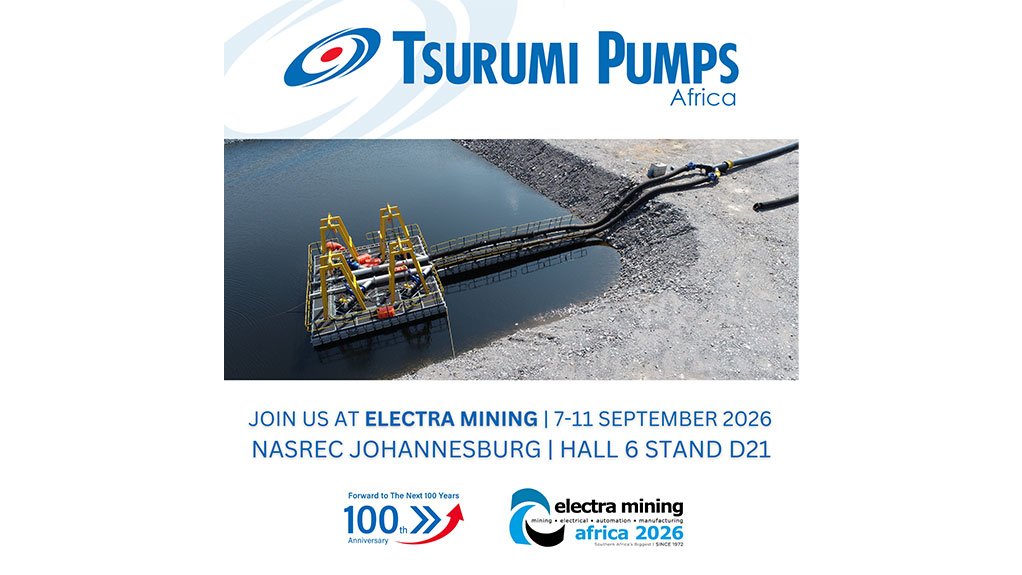
At a diamond-mining operation in Angola, four Tsurumi LH8110 pumps were installed on a modular pontoon system, demonstrating the scale of water-transfer capacity required for demanding African mining applications.
Building Resilience and People
African mines operate in remote areas with constrained electrical infrastructure, requiring generators and long cables. Kotze highlights that these constraints mean that correct motor sizing is critical as it affects energy demand, cable selection, control equipment and the ability to respond during peak inflow.
Standby equipment supported by adequate power, correctly sized discharge lines, suitable valves, lifting arrangements and tested controls is essential in case of sudden inflow, maintenance or equipment failure.
Responsible planning must protect production while recognising water as a shared resource, asserts Kotze. Abstraction, re-use, treatment and discharge decisions affect surrounding communities, downstream users and catchment areas, and poor water management creates operational, environmental and reputational risk.
Meanwhile, Tsurumi affirms its support for creating pathways for women in mechanical engineering, electrical, hydrology, environment, maintenance and operational management, confirming that initiatives such as ‘Women in Mining and Engineering’ build leadership, skills development and technical responsibility. The company notes that building capacity must include meaningful site exposure, technical responsibility, structured mentorship and access to decision-making roles.
Protecting Production
Tsurumi sees mine dewatering as a complete operating requirement, noting that mine-water systems should be judged by the production they protect, the access they preserve and the operational risk they remove. It states its objective is always to ensure accessible working areas, protect critical infrastructure, control operating costs and reduce disruption.
Tsurumi invites Electra Mining Africa 2026 delegates to Hall 6, Stand D21, to discuss all aspects of mine dewatering.